
Upon completing my apprenticeship, I was offered a post in the inspection department. At 21 years of age, the slow pace and what seemed like easy work led to boredom. It wasn’t long before I regularly participated in the plant’s suggestion scheme. A handy bonus for each idea that resulted in savings for the company. Ideas flowed, and money was collected! Indeed, when ‘piece work’ was introduced, I went top-dollar, developing my own system to do the work in half the time while getting paid for it. Time for the job to be reassessed by time and motion, and duly done, the job time stayed the same! Shop management double-checked all my work and found it to be 100% correct. The department quickly encouraged me to go to the Design Office, if only to save their suggestion scheme budget a few pounds. I was given a good office job with a contract that ensured my ideas would no longer be paid for!
One piece of advice freely given was from a friendly shop manager who told me that you have to be prepared to move around if you want to get on inside the organisation. The Fuel Element Design Office provided the grounding for this opportunity. I’d always considered myself reasonably good at technical drawing (which makes up for my lack of skill in freeform art), particularly when I discovered that my drawings were being used at the technical college as the standard students needed to aspire to!
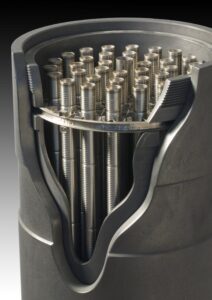
A very sound grounding, with lots of very clever engineers, in the design of various nuclear fuel, fuel elements and components for Magnox, Advanced Gas-Cooled and Prototype Fast Breeder Reactors which after several years and a promotion, stood me in good stead for my next progression. I grasped a move to the Inspection and Progress (outsource) department. I then started to travel off-works to visit companies contracted to supply the authority.
Note: I recall very well from this time, Friday 30 March 1979, when on returning from the south coast, I met up with a colleague at Euston Station. We boarded the train and took our seats. As the train was about to depart, we were surprised to have William Whitelaw and his Secretary take their seats alongside us for the journey north. The train’s first stop was to be Crewe. Surprisingly, the train stopped at Rugby, and everyone was ordered off the train. William Whitelaw, his Secretary, and his luggage were taken to an anteroom shortly after returning to the carriage with security guards, and everyone was ordered back on board. It transpired that Airey Neave had been blown up on his way out of the car park at the Houses of Parliament that evening. Security asked everyone in the carriage to find new seats in another part of the train. That is everyone except me and my colleague, encouraged to stay by the discreet display of their weaponry!
In my view, there is no better way to learn than to design and then to go to companies to see how your drawings are interpreted for manufacture. This was a great experience, and I travelled to various factories up and down the country and abroad. Indeed, along with exotic metals, I became knowledgeable on graphite, a ceramic, following the process from the raw material, coke, and turning it into finished Magnox and AGR Fuel Element sleeves. It was this that instigated my next move. A change in my departmental head and an individual’s wish to get some of my action resulted in me being moved back into the works as a shift shop manager responsible for the quality of fuel pellet production. It was not my bag when I was stuck in an office with no windows, sometimes working a night shift.

At the earliest opportunity, I was invited to apply for the job of Quality Manager at our company’s head office at Risley (near Warrington), not with my parent company, which was British Nuclear Fuels at this time, but with Nuclear Transport Ltd an operation manned by staff from the United Kingdom, France and Germany. The task was to arrange for the transport of irradiated fuel from reactors to the two re-processing plants at Sellafield (Windscale) in the UK and Cap de la Hague, near Cherbourg in France. The arrangements were very good too, an enhanced salary, keeping my service and benefits from my prime employer, as we were effectively on secondment.
Working with European colleagues, it was a great job in a company of just 80 people. We were responsible for the land and channel transport of irradiated nuclear fuel from all European reactors to the reprocessing plants. The job involved a tremendous amount of travel. It also brought me into the realm of dealing with the government concerning transport licences et al. Sitting on working parties for developing IAEA (International Atomic Energy Agency) standards and the like. After some seven years, staffing issues became difficult, and following a heavy run-in with the head of our office, I requested a transfer back to BNFL.
 I moved to the Quality Assurance Department, remaining at Risley, populated by six other engineers of the same status. Allocated as a Projects Quality Manager, I took on the role and responsibility of a team of engineers involved in designing and constructing waste treatment plants (nuclear) at Sellafield. These projects were so large (designated design & build) that external contractors were employed to design and procure major equipment items and build the plants at the sites. This resulted in managing a team at Head Office and onsite at Sellafield, as well as contractor staff at the various locations of the various contracts.
In April 1986, the Chernobyl disaster impacted everyone in the nuclear industry worldwide. At the time, BNFL was looking to secure funding from the stock market (to go privatised), which then collapsed. The business had to reduce capacity and, as such, looked for voluntary redundancies from the 18,000 employees at the time. I thought long and hard, and after weighing up my service years, I saw another opportunity. My requests for ‘terms’ were turned down three times!
During this time, I was invited to Whitehall for an interview with the Regulatory Authority, in essence, to provide direct guidance to a government minister who was responsible, amongst others, for nuclear transport policies. I was offered the job, but the terms and conditions, based on regular civil service scales, were poor, so I declined. I later learned that my refusal was used to help engineers in the department with their payment aspirations.
The company changed, and our services were offered to external organisations. We gradually became a contractor rather than a client. While running my section, I was asked to summarise those services to a potential client, Devonport Royal Dockyard (DRD). I later learned that DRD had won a contract to set up a project with other organisations as a joint venture to bid to the MOD for a nuclear submarine refitting facility at the dockyard in Plymouth. Another team was set up for a rival bid from Rosyth in Scotland.
After a short while, I was asked to provide three months of guidance on the infrastructure for setting up a team at the naval base. I did this while still travelling and managing staff at HQ and Sellafield. It was remarkable, and I remember it well: seven of us from different engineering backgrounds, each issued with just one A4 pad and two pencils!
Well, no doubt you may have guessed. I worked well with the organisation, and it wasn’t long before they wished for me to stay at Devonport for the duration of the bid process. Five years later, the MOD kept both teams at Devonport and Rosyth working on the project bid. By this time, the bid team had grown to 150 people from five organisations. It was a perfect time, it turned out, to get my ‘terms’ as I would not accept returning to the ever-changing world of BNFL. Eventually, the company board approved my request for ‘terms’ but on the understanding that I would not divulge that I had gotten them. After three years at Devonport, I left my company with severance and my pension payments intact.
On finally leaving the Dockyard late one Friday afternoon to return for good up north, the Managing Director tapped me on the shoulder and asked me to return the following Monday. I was offered to continue with my work at the dockyard, but at the rate they had been paying BNFL. Now I knew why BNFL did not wish me to leave! A handsome salary for the next two years saw the dockyard win the bid before leaving on my own accord for new ventures. A new free spirit of adventure was to begin.